Natural Sweeteners For Coffee: How to Choose by Flavor and Form
Compare jaggery, honey, maple syrup and other natural sweeteners for coffee by flavor, mixing method and drink style, with practical sugar guidance.
Natural sweeteners for coffee work best when their flavor suits the drink and their form is easy to mix. For a familiar, fairly neutral sweetness, start with a fine sweetener such as jaggery powder; choose solid jaggery when you want a more pronounced traditional flavor and do not mind dissolving it first. Honey and maple syrup bring their own aromas, while date syrup can make a cup taste noticeably fruity. Add a little, stir well, and adjust to your preference: no natural sweetener is automatically a better choice for every coffee or a sugar-free one.
Choose a sweetener for the cup you actually drink
“Coffee” covers very different drinks. A small, intense black coffee gives a sweetener less room to hide; a milky coffee can soften its flavor, while an iced drink makes thorough mixing more important. Decide what you want the sweetener to do: disappear into the background, add a complementary note, or become part of the drink’s character.
For a first trial, compare sweeteners in the same coffee, prepared the same way. Change only the sweetener, and begin with less than you think you need. This makes it easier to notice whether the sweetener’s own flavor is pleasant in the cup, rather than confusing that effect with a different roast, milk, or brewing method.
- For subtle sweetness: try a fine, mild-tasting sweetener and use a light hand.
- For a richer, traditional note: try jaggery, especially in coffee with milk or spices.
- For a distinct floral or fruity note: try honey or date syrup, then decide whether that flavor belongs in your usual cup.
- For iced coffee: choose a form that stirs in easily, or dissolve a solid sweetener before adding it to the cold drink.
These are starting points, not fixed pairings. A strongly flavored sweetener can be enjoyable in black coffee if that is the taste you want; a mild one may be a better everyday choice when you want the coffee itself to lead.
What each option brings to coffee
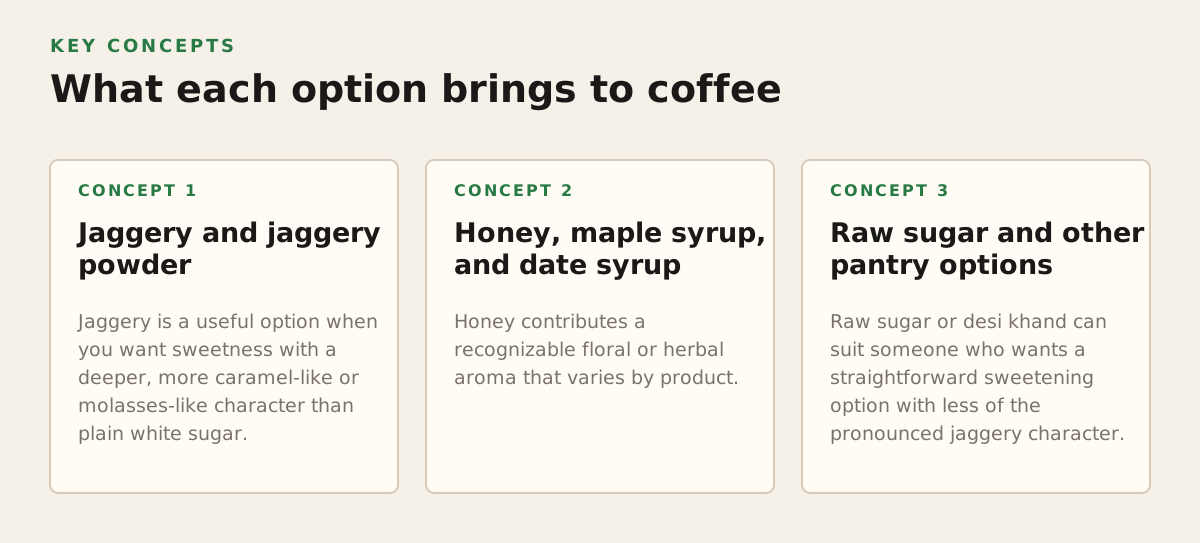
Sweeteners differ not just in sweetness but in aroma, aftertaste, and how much they change a drink. Product names alone do not guarantee identical flavor: processing and the particular product matter, so use these descriptions as cues for what to taste rather than promises about every jar or pack.
Jaggery and jaggery powder
Jaggery is a useful option when you want sweetness with a deeper, more caramel-like or molasses-like character than plain white sugar. In coffee, that character can complement milk, cardamom, or other warming spices. In a light or delicate black coffee, however, it may become the most noticeable flavor in the cup. If you want to explore a traditional solid form, see jaggery gur; it is worth choosing only if you are comfortable dissolving it before drinking.
Fine jaggery powder, also called shakkar, is easier to portion and stir into a hot drink than a solid piece. It still has its own flavor, so “fine” describes the texture rather than meaning taste-neutral. For a quick cup, or when you want the sweetness to distribute without preparing a separate syrup, jaggery powder is the more convenient form.
Honey, maple syrup, and date syrup
Honey contributes a recognizable floral or herbal aroma that varies by product. It may suit a milky coffee or a drink with spices, but can distract from coffee if you want a clean, roasted taste. Maple syrup brings its own distinctive flavor; use it when that note sounds appealing, not as an invisible substitute. Date syrup tends to make a more fruit-forward impression, so it is best treated as a deliberate flavor choice.
Liquid sweeteners are convenient to measure and stir, particularly in a cold drink, but they can change the cup’s aroma and body. If you are choosing among them, taste each in the drink you actually make rather than assuming a syrup that works in tea, porridge, or baking will work equally well in coffee.
Raw sugar and other pantry options
Raw sugar or desi khand can suit someone who wants a straightforward sweetening option with less of the pronounced jaggery character. Its exact taste and texture depend on the product, so check the product description and label rather than relying on the name alone. A sweetener marketed as natural is not necessarily neutral, minimally processed, or lower in sugar; those are separate questions.
Match the form to the way you prepare coffee
Form affects effort as much as flavor. A solid piece has to break down and dissolve; powder is ready to stir; syrup is already liquid. For hot coffee, stirring while the drink is hot helps distribute a sweetener. For cold coffee, a solid piece or powder may settle or leave undissolved grains, so prepare it separately or select a liquid form if that better suits your routine.
Hot coffee: powder, liquid, or a prepared solid
For a quick mug, powder is usually the least fussy form: add it to hot coffee and stir until it is evenly dispersed. Honey, maple syrup, and other pourable sweeteners can also be stirred straight into a hot drink. With solid jaggery, break off a small piece and dissolve it in hot water or in a small amount of hot coffee before mixing it into the full cup. This reduces the chance of finding a hard piece at the bottom.
That extra step can be worthwhile if you like the deeper taste of solid jaggery or want to prepare sweetened coffee for more than one serving. But if you want a quick single cup, the convenience of a fine powder may matter more than the difference in texture. Do not assume every solid product dissolves at the same rate: piece size and how thoroughly you stir affect the result.
Iced coffee: make mixing predictable
Cold liquid does not make solid sweeteners disappear simply because you stir longer. Dissolve jaggery or granulated sweetener in a little hot water or hot coffee first, let the mixture cool, and then add it to the cold drink. If you regularly make iced coffee and want fewer preparation steps, a liquid sweetener is a practical alternative. Stir again after adding milk or ice so the sweetness is evenly distributed.
For a batch, prepare the coffee and sweetener separately before combining them. That gives you a chance to taste the sweetened coffee before adding milk or ice, and avoids trying to correct a drink after a concentrated sweetener has settled. Make only the amount you plan to use and handle storage according to the product’s label; the ingredients and storage instructions can differ between products.
- One hot cup: use powder or a pourable sweetener for a quick stir-in.
- Solid jaggery in a hot cup: dissolve it first, then taste before adding more.
- Iced coffee: pre-dissolve a solid or granular sweetener, or use a liquid form.
- Shared batch: sweeten gradually and taste before adding milk or ice.
Adjust sweetness without losing the coffee
It is easy to add more sweetener; it is harder to remove it. Start with a small amount, stir fully, and taste before adding another little amount. If the cup tastes flat or overly sweet, first check whether the sweetener has dissolved evenly. A concentrated patch at the bottom can make the last sip far sweeter than the first.
When comparing options, keep your measure consistent. Use the same spoon or pour size for each trial, but do not treat an equal volume of different products as an equal amount of sugar: their textures and densities can differ. If you need a precise nutritional comparison, consult the nutrition information on the actual product rather than inferring it from appearance or from a general description.
- If the coffee tastes too sweet, reduce the amount before switching to a more strongly flavored sweetener.
- If the sweetener overwhelms the coffee, choose a milder flavor or use less.
- If a cold drink tastes uneven, dissolve the sweetener first and mix again.
- If you cannot taste the coffee’s own character, try the same drink with less sweetener before changing the beans or brew.
For people keeping track of sugar, “natural” does not mean sugar-free. The FDA’s guidance on added sugars explains how sugars from honey and syrups fit into added-sugar labeling. The World Health Organization’s guideline on sugars includes sugars in honey and syrups in its definition of free sugars. These terms serve different guidance contexts, but neither makes honey, syrup, or jaggery an unlimited option.
For a packaged sweetener, check the ingredient list and nutrition panel on that specific pack. Product formulations and serving information can differ. The USDA FoodData Central is a reference database for food composition, but a general database entry should not be treated as a substitute for the label on the product you buy.
Make a practical choice for home or a coffee menu
At home, the best choice is the one that fits both your preferred taste and the way you make coffee. If one person wants a lightly sweetened black coffee and another wants a spiced milk coffee, keep the coffee unsweetened until serving. That lets each person add a preferred sweetener without changing the whole pot. It also makes it easier to notice how much is being added.
For a home baker or cook using the same sweetener in coffee and recipes, consider whether the flavor suits both uses. Jaggery may bring a welcome depth to some drinks and baked goods, but its taste can be too noticeable in a coffee where you want a clean finish. Keep a separate mild option if you want one sweetener for a wider range of cups and recipes.
Cafés, bakeries, and restaurants have an additional decision: consistency. Choose a form staff can portion and mix reliably for the drinks on the menu. A powder can simplify hot drinks; a pre-dissolved preparation or a liquid sweetener can be easier for cold service. Before adding an option to a menu, check how the actual product tastes in the recipe, how it mixes in the serving temperature, and what ingredient and nutrition information you need to disclose. Do not promise that a sweetener is healthier simply because it is traditional or less refined.
- For everyday hot coffee: choose the form you will use without extra effort.
- For an ingredient-led drink: select a sweetener whose aroma is meant to be noticed.
- For a café recipe: write down the product and preparation method so staff can reproduce the intended cup.
- For a bulk purchase: confirm pack options, current availability, and bulk terms with the supplier instead of assuming they are fixed.
Zaiqa-e-Cholistan offers solid jaggery gur and fine jaggery powder, alongside other pantry products, with wholesale supply and delivery across Pakistan; ask for current pack and bulk details before ordering. If jaggery suits the coffee you want to make, explore Zaiqa-e-Cholistan for product information or guidance.
Authored with NotFair SEO
Explore Our Premium Pantry Collection
Discover clean-label essentials across sweeteners, spices, seeds, and wellness powders.
Shop Products