Natural Sweeteners For Tea: Choose by Taste, Form and Label
Natural sweeteners for tea: compare jaggery, shakkar, raw sugar, honey and stevia by flavour, form and label to choose a cup that suits you.
Natural sweeteners for tea include jaggery, jaggery powder (shakkar), raw sugar, honey and stevia-based products. Choose by the flavour you want and how easily you can portion and stir the sweetener: jaggery and honey add their own character, while a powder or granules are convenient to measure. “Natural” does not mean sugar-free, so check the product label if you are monitoring sugars.
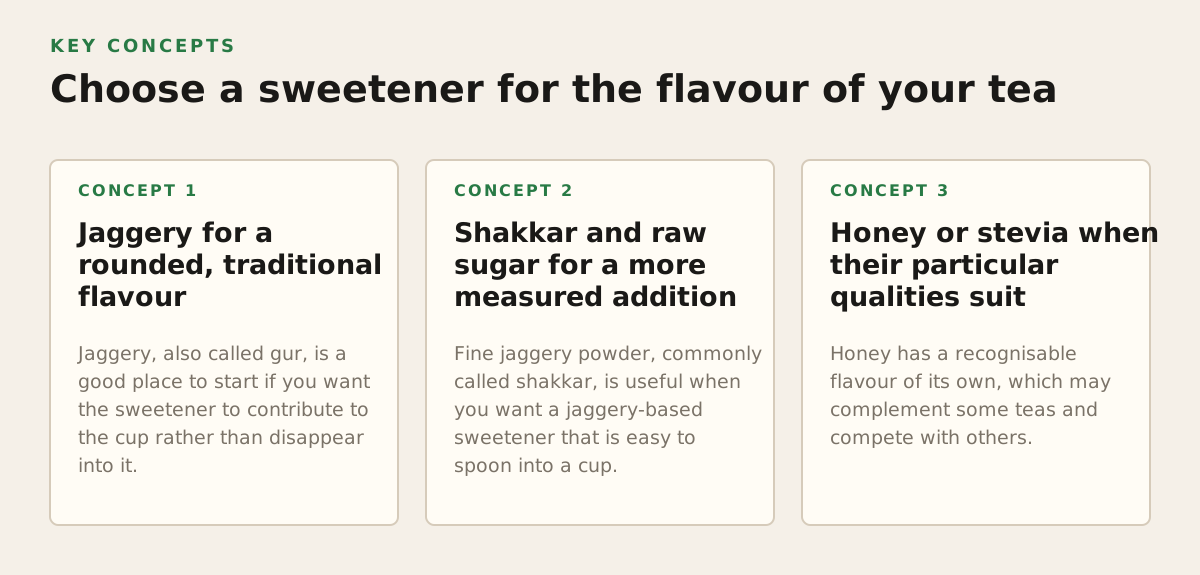
Choose a sweetener for the flavour of your tea
Start with a simple question: should the sweetener bring a flavour of its own, or should it mainly add sweetness? A distinctive sweetener can suit a robust brew, while a lighter tea may leave less room for extra aromas. Neither pairing is a rule: tea strength, milk, the sweetener itself and your preference all affect the result. Taste a small amount in the tea you actually drink before choosing a pantry staple.
Jaggery for a rounded, traditional flavour
Jaggery, also called gur, is a good place to start if you want the sweetener to contribute to the cup rather than disappear into it. Its flavour can be more noticeable than that of plain sugar, so it may suit strong milk tea when you welcome that character. In a delicate or lightly brewed tea, begin with less and taste before adding more. A solid piece also needs enough stirring and heat to dissolve; otherwise, the cup may not taste evenly sweet.
Jaggery is not a single guaranteed flavour profile. Products can differ, so treat the first cup as a trial rather than assuming that another brand or batch will taste exactly the same. If you want to compare the solid form, see jaggery gur. Check the particular product information for its form and ingredients rather than relying on the word “gur” alone.
Shakkar and raw sugar for a more measured addition
Fine jaggery powder, commonly called shakkar, is useful when you want a jaggery-based sweetener that is easy to spoon into a cup. It still brings jaggery’s own flavour, so it is not necessarily a neutral substitute for sugar. Compare it with jaggery powder if you want to consider the powder form. Raw sugar, also known as desi khand in the supplied product range, is another granular option. Use whichever taste you prefer; the name or colour by itself does not tell you how sweet your finished tea will seem.
Honey or stevia when their particular qualities suit
Honey has a recognisable flavour of its own, which may complement some teas and compete with others. Choose it because you like that note, not on the assumption that it makes a sweetened drink sugar-free. Stevia-based products belong to a different category from jaggery, honey and sugar: they are high-intensity sweeteners, and products can differ in their ingredients and serving directions. If you are unsure what a particular product contains, use its ingredient list and nutrition information to decide.
- Want jaggery flavour: try gur or shakkar in a robust cup, beginning with a modest portion.
- Want a familiar granular form: compare raw sugar with a powder in the same tea.
- Want a noticeable aromatic note: try honey only if its flavour belongs in that cup for you.
- Want a high-intensity sweetener: check the product’s sweetener name, ingredients and serving guidance.
Match the form to your cup and routine
Form affects portioning and mixing; it does not tell you how much sweetness you will prefer. A spoonful of powder, a chunk of jaggery and a spoonful of honey are not equivalent measures. They differ in shape and consistency, and a spoon may hold different amounts of each. For a fair taste comparison, use the same tea and cup, add each product in small steps, and judge the finished drink rather than assuming a volume conversion.
Powder and granules for individual cups
Powder and granules can be scooped directly into a cup, which makes them practical when people in one household want different sweetness levels. Stir well before tasting, especially if the drink contains milk or the powder has settled at the bottom. If you keep several sweeteners in the kitchen, use a clean, dry spoon and follow each product’s storage directions. Powder is convenient, but a smaller scoop is not automatically a better choice: adjust according to the taste and the label information relevant to your needs.
Solid pieces when you want to portion gur
A piece of gur can be less convenient for a quick, repeatable cup if it is difficult to break or pieces vary in size. Break or shave off a small portion, let it dissolve in the hot tea and stir before tasting. For a shared pot, dissolve the jaggery thoroughly and taste the pot before serving. That is more reliable than assuming that one piece will give every cup the same sweetness, particularly if the pot is not stirred between pours.
Liquids for easy stirring, with careful measuring
Honey and other syrups can be spooned into a drink and stirred, but they can be sticky to handle. Add a little, mix it in and taste; do not swap a spoonful of syrup for a spoonful of dry sugar as if the measures were interchangeable. If you are sweetening a pot, mix thoroughly and taste before adding more. A liquid sweetener may also contribute its own flavour, so consider both aroma and sweetness when deciding whether the amount is right.
- For cup-by-cup adjustment: keep the sweetener beside the tea and let each person add their own.
- For a shared pot: dissolve and stir the sweetener before tasting the finished tea.
- For repeatable service: use the same scoop or spoon, then calibrate it for the specific product and recipe.
- For pantry handling: use clean utensils and follow the package’s storage directions.
Read “natural” as a description, not a sugar claim
The source of sweetness and the amount of sugar in a drink are different questions. The World Health Organization’s guideline defines free sugars to include sugars added to foods and drinks, as well as sugars naturally present in honey and syrups. It recommends limiting free sugars; replacing table sugar with honey or syrup does not, by itself, remove the drink’s free sugars. See the WHO guideline on sugars intake for the definition and recommendations.
The NHS also counts honey and syrups among sources of free sugars, alongside sugar added to food and drink. If your aim is to have less sweetness, changing from sugar to honey is not the same as reducing the amount of sweetener. For background on how these sugars are treated in the diet, see the NHS guide to sugar in the diet. The practical comparison is the amount you use and the nutrition information for the product, not whether the front label says “natural,” “raw” or “unrefined.”
Pack labels and rules vary by country. In the United States, the FDA explains how added sugars are shown on Nutrition Facts labels and gives honey and syrups as examples. That guidance is useful context, but it is not a substitute for checking the pack sold where you shop. Pakistani shoppers should read the information on the local product label and ask the seller or manufacturer if a detail they need is missing. See the FDA explanation of added sugars on the Nutrition Facts label.
Stevia-based products also need a label check. The FDA’s overview describes high-intensity sweeteners used in food in the United States, including steviol glycosides; a product sold under a familiar sweetener name may still contain other ingredients. Check the specific product’s sweetener name, serving size, ingredient list and nutrition information rather than inferring its contents from “stevia” on the front. The FDA overview of high-intensity sweeteners provides information about the US context.
If you are choosing a sweetener because of diabetes, a medical diet or another health concern, do not use “natural” as a shortcut for deciding what is suitable. Check the product information and ask a qualified health professional for advice that fits your circumstances. For ordinary taste adjustment, use the smallest amount that still makes the tea enjoyable to you.
Compare sweeteners by tasting them in the same tea
Side-by-side tasting helps separate the sweetener’s flavour from changes in the drink. Keep the tea, cup size and milk the same, and change only the sweetener. If you alter the brew strength or add more milk at the same time, it becomes harder to tell whether the sweetener or the tea itself changed the balance. This is a tasting method, not a health target or a universal recipe.
- Brew your usual tea with the same tea, water and milk you normally use.
- Add a small portion of one sweetener and stir until it is evenly mixed.
- Taste before topping up. Notice the sweetness and any flavour the sweetener adds.
- Repeat with another form in a fresh cup of the same tea, adjusting each one in small steps.
- Record what suited you—the product form, approximate portion and tea style—so you can repeat the cup.
For example, if you enjoy the taste of jaggery in strong milk tea but find it too prominent in a lightly brewed cup, keep the same jaggery and reduce the portion in the lighter tea. That tests whether the difference is the amount or the tea style without assuming that every jaggery product behaves identically. If you prefer a sweetener’s flavour not to stand out, compare a smaller amount of a milder-tasting option rather than switching several parts of the recipe at once.
If you are trying to become accustomed to less sweetness, reduce the amount gradually across your usual cups and notice whether the tea remains enjoyable. A strongly flavoured sweetener can change the character of the drink without answering whether you want less sweetness overall. Keep those two decisions separate: first choose the flavour, then decide the amount.
Choose a product for home or food-service use
For a household, the choice often comes down to flavour, form and how people prefer to sweeten their own cups. A powder can be easier to portion individually; solid gur may suit someone who specifically wants jaggery in pieces; a liquid can be simple to stir but requires careful spooning. None is automatically the best option for every tea. Compare products in the kind of tea you actually make, and check the pack for product form and ingredient information.
Cafés, bakeries and restaurants have an additional decision: can staff serve the tea consistently? A distinctive sweetener can make sense when its flavour is part of the intended drink. If the goal is simply to sweeten tea without noticeably changing its character, a strong aroma may be a poor fit. Before adding a sweetener to a menu or recipe, settle on a portioning method and taste the drink prepared that way. Write down the product and measure used so another staff member can reproduce the choice.
- Product identity: confirm whether the item is solid jaggery, jaggery powder, raw sugar, honey or another sweetener.
- Recipe fit: check that it dissolves and tastes right in the actual tea or drink you serve.
- Portioning: decide how staff or household members will measure and stir it.
- Supply details: verify current pack options, price and availability directly with the seller; these details can change.
- Label information: review ingredients and nutrition information, and ask the supplier if a required detail is not shown.
For home tea, compare gur, shakkar and raw sugar by the flavour and form you prefer, then adjust the amount to your cup. Zaiqa-e-Cholistan offers these Cholistan-sourced pantry sweeteners and supplies wholesale buyers; check the available product details or ask for guidance through Zaiqa-e-Cholistan.
Authored with NotFair SEO
Explore Our Premium Pantry Collection
Discover clean-label essentials across sweeteners, spices, seeds, and wellness powders.
Shop Products