Organic Natural Sweeteners: How to Choose for Cooking and Buying
Compare organic natural sweeteners by form, recipe fit, and label evidence—then choose jaggery, shakkar, or another option without assuming it is healthier.
Organic natural sweeteners can mean different things on a shopping list: “natural” describes a broad category, while “organic” is a claim that needs supporting certification or documentation. For Pakistani tea, cooking, and baking, choose by the ingredient’s form and how you will use it; for a health decision, count it as sugar rather than assuming jaggery, honey, or raw sugar is a healthier substitute. Jaggery gur and jaggery powder are options from Zaiqa-e-Cholistan, but the available product information here does not establish that either is certified organic.
What “Organic Natural Sweeteners” does—and does not—tell you
Natural is not a recipe instruction or a nutrition category. It may describe a product’s source or processing in everyday marketing, but it does not tell you how sweet it is, whether it will dissolve in tea, or whether it carries an organic certification. Those are separate questions, and the package or seller should answer them separately.
Organic is a production and labeling claim tied to a particular standard. For example, the USDA explains the rules and certification system behind products marketed as USDA organic; that does not, by itself, establish the certification status of a product sold in Pakistan. Check the actual product’s certification details and the certifying body rather than relying on a word in a product name. See the USDA organic standards overview.
That distinction matters because shoppers may be trying to solve three different problems at once: avoid a particular processing method, find a sweetener that suits a recipe, or buy an independently verified organic product. One label may not answer all three. Before comparing products, decide which claim matters most to you and look for evidence for that claim.
- For a recipe: ask whether you need a fine powder, a pourable syrup, or a solid sweetener.
- For an organic claim: look for the named standard, certifier, or documentation, not just “natural.”
- For nutrition: check the amount of sugar per serving and how much you use.
- For origin: check whether the seller identifies where the ingredient is sourced.
How common sweetener forms differ in the kitchen
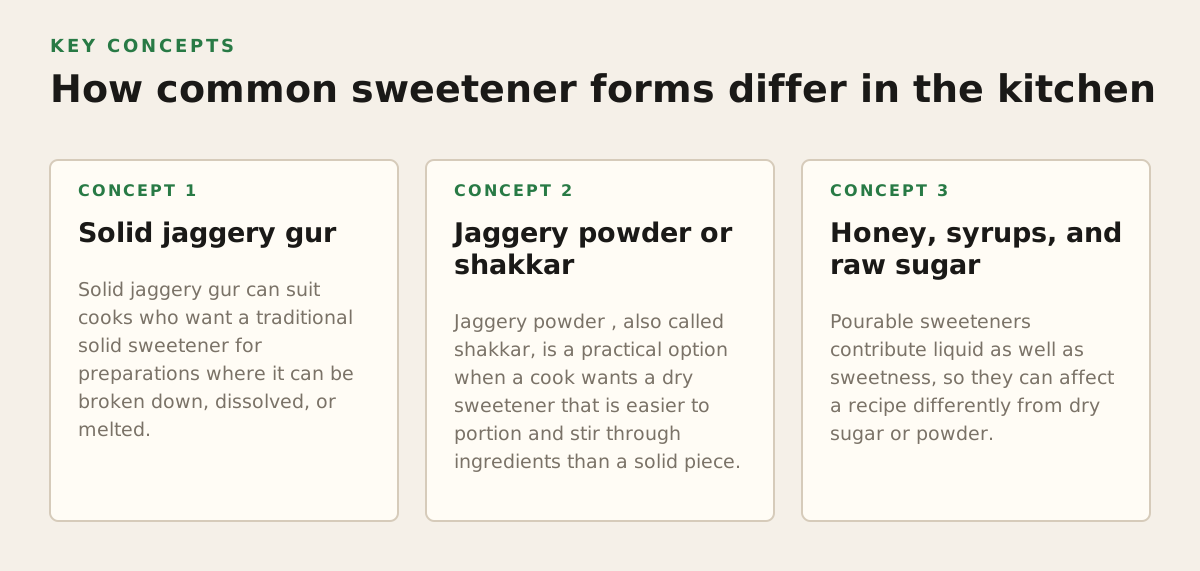
For households and food businesses, form is the useful first comparison: it determines how easily an ingredient measures, dissolves, and blends into a mixture. It does not establish that one form is healthier, more organic, or suitable for every recipe. A seller’s ingredient and product information should clarify what is actually being sold.
Solid jaggery gur
Solid jaggery gur can suit cooks who want a traditional solid sweetener for preparations where it can be broken down, dissolved, or melted. Its physical form means it may need an extra preparation step compared with a fine powder. If a recipe depends on quick, even distribution—for example, a batter mixed briefly—check whether the gur can be grated or dissolved without changing the recipe’s liquid balance. Zaiqa-e-Cholistan sells jaggery gur; see the product page for jaggery gur.
Jaggery powder or shakkar
Jaggery powder, also called shakkar, is a practical option when a cook wants a dry sweetener that is easier to portion and stir through ingredients than a solid piece. Powder is not automatically interchangeable with white sugar: its flavour and the recipe’s intended texture may differ. If you are choosing it for a familiar recipe, start with a small batch and assess the result before changing a larger production run. Zaiqa-e-Cholistan sells jaggery powder.
Honey, syrups, and raw sugar
Pourable sweeteners contribute liquid as well as sweetness, so they can affect a recipe differently from dry sugar or powder. Raw sugar remains a dry, granular option, while honey and syrups are liquids; their names alone do not predict a precise one-for-one substitution. Zaiqa-e-Cholistan also sells raw sugar (desi khand), but the supplied business information does not establish the exact texture or performance of every other sweetener discussed here.
Use these distinctions to shortlist an ingredient, not to assume a fixed conversion. If you are working from a recipe written for another sweetener, preserve the intended texture and mixing method where possible. A substitution that changes both sweetness and liquid content can make it difficult to tell what caused a different result.
Choose a sweetener for the job, not a health halo
Jaggery, honey, syrups, and sugars may differ in source, flavour, and form, but “natural” does not mean sugar-free. The World Health Organization recommends reducing free sugars across the diet; its guideline advises keeping them below 10% of total energy intake, with a further reduction below 5% suggested for additional benefits. These are overall dietary recommendations, not a special allowance for one sweetener. Read the WHO guideline on sugars intake.
The US Food and Drug Administration includes sugars from honey and syrups among added sugars on its Nutrition Facts label guidance. Its labeling rules do not determine how a Pakistani product is labeled, but the guidance illustrates why a sweetener’s source does not make its sugar contribution disappear. See the FDA explanation of added sugars. For UK dietary guidance, the NHS likewise groups sugars in honey and syrups as free sugars; see its page on sugar in the diet.
For tea or coffee, the most useful change may be to adjust how much sweetener you add, rather than switching products while keeping the same amount. In baking, first consider whether the recipe needs a dry ingredient or a liquid one. In a café or bakery, consistency between batches may matter more than a broad “natural” description. None of these choices requires treating jaggery as a health food.
- Tea or coffee: choose a form that is easy to portion and stir into your usual drink.
- A dry mix: consider a powder or granulated ingredient when even distribution matters.
- A recipe with a liquid sweetener: check how the liquid affects the mixture before substituting a dry ingredient.
- Lowering sugar intake: compare the amount used, not just the sweetener’s name or source.
Check the label and ask for evidence before buying
Match each claim to a check. A product can have a named source, a particular form, and an organic claim, but those details are not interchangeable. If a seller says a product is organic, ask what standard or certifier supports that statement and whether the evidence applies to the product you are buying. If the response is only “natural” or “traditional,” that does not answer the certification question.
For a packaged product, review the ingredient list, product name, net quantity, storage directions, and any certification mark or documentation provided. If you are buying loose goods or ordering in bulk, request the same information before committing. The goal is not to demand a specific certification where you do not need one; it is to avoid paying for a claim that the seller cannot clarify.
- Identity: Is the product solid gur, powder/shakkar, raw sugar, honey, or a syrup?
- Ingredients: Does the ingredient information match the product name and your dietary needs?
- Organic status: Which standard or certifier is being claimed, and can the seller provide supporting details?
- Origin: Is the source stated clearly, and does it matter to your purchase?
- Handling: Are storage and pack details clear enough for your household or business?
Do not infer certification from a place name, a traditional production story, or words such as “pure.” Those may describe other product attributes, but the organic claim still needs its own evidence. Zaiqa-e-Cholistan shares sourcing and traditional jaggery-making information and offers product guidance through WhatsApp; buyers who need a specific certification should ask directly what documentation is available for the product they intend to order.
For cafés, bakeries, and retailers: qualify supply before scaling
For a food business, a sweetener is not just an ingredient choice; it is also a purchasing and production decision. Confirm the pack and supply details before standardizing a recipe, especially if staff will portion the ingredient repeatedly or the same product will be used across several menu items. The supplied information confirms that Zaiqa-e-Cholistan accepts wholesale orders, but it does not establish current wholesale prices, pack sizes, stock, or lead times. Request those details directly rather than planning around assumptions.
Test production fit separately from supplier fit
First, decide whether the candidate sweetener works in the recipe. Then confirm that the supplier can provide the product form and quantity your business needs. Keeping those decisions separate avoids accepting a recipe compromise just because a particular pack is available, or choosing an ingredient that works in a test but cannot be supplied in the required format.
For a bakery, compare how the ingredient handles in the actual application: mixing, dissolving, flavour balance, and finished texture. For a café, consider serving preparation and portioning. A grocery retailer should also confirm how the product is identified and packed for resale, along with any information needed for its own product listing. These are operational checks, not claims about which sweetener performs best.
Use a controlled recipe trial
When a candidate looks suitable, make a small, documented trial against your current recipe. Keep the recipe method and other ingredients consistent, change only the sweetener choice, and record the result in terms your team can repeat: flavour, ease of mixing, texture, and portioning. This trial answers whether the ingredient fits your product; it does not verify organic certification or guarantee consistent future supply.
Before a larger order, separately confirm the supplier’s current bulk price, available pack options, product identity, and delivery arrangements for your location. Ask whether the quote applies to the particular product and quantity you need. Zaiqa-e-Cholistan supplies sweeteners and pantry powders to wholesale buyers and ships across Pakistan, but specific terms should be confirmed for each order.
- Food-service buyers: request the form and pack details needed for repeatable preparation.
- Bakeries: trial the ingredient in the actual recipe before changing production specifications.
- Retailers: confirm product naming, pack information, and any claims you plan to make to customers.
- All wholesale buyers: get current price, quantity, stock, and delivery terms directly before placing an order.
A practical choice for Pakistani kitchens
For everyday cooking and tea, start with the form you can use consistently: solid jaggery gur where breaking down a solid sweetener suits the preparation, or jaggery powder where a dry ingredient is easier to measure and mix. For baking, check the recipe’s physical requirements before substituting; for a business, trial the recipe and confirm supply terms as separate steps. If “organic” is essential, make the purchase conditional on evidence for that claim rather than treating “natural” or “traditional” as proof.
Choose by form, verify the claim, and count the sugar—those checks answer more than a broad label can. Zaiqa-e-Cholistan offers jaggery gur, jaggery powder, raw sugar, and wholesale supply; explore its products at Zaiqa-e-Cholistan, and ask the business directly about any certification or order detail you need to confirm.
Authored with NotFair SEO
Explore Our Premium Pantry Collection
Discover clean-label essentials across sweeteners, spices, seeds, and wellness powders.
Shop Products